
B2B Prospecting: A Complete Guide to Finding, Verifying, and Reaching the Right Buyers
B2B prospecting is the sales-led process of identifying potential business buyers, researching whether they fit your ideal customer profile (ICP), finding the right people inside those companies, and initiating relevant conversations. Unlike inbound lead generation, prospecting does not require a buyer to submit a form and otherwise raise their hand first.
The goal is not simply to create a larger contact list. Effective prospecting connects the right company, the right person, the right business context, and the right timing before outreach begins.
Modern B2B prospecting commonly involves account research, contact discovery, data verification, buying-signal analysis, multichannel outreach, and CRM tracking. Current sales guidance from Salesforce similarly frames prospecting around defining an ICP, researching accounts, identifying prospects, and building a sales cadence. (Salesforce)
What Is B2B Prospecting?
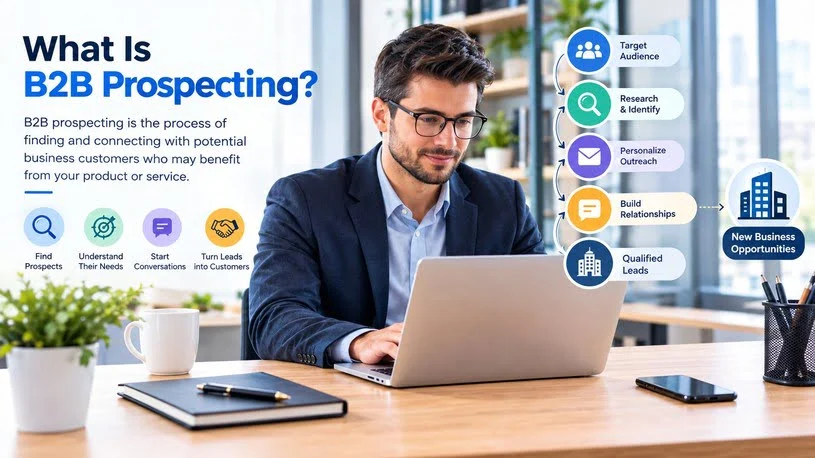
B2B prospecting is the process of identifying, researching, verifying, prioritizing, and contacting potential business buyers to create new sales opportunities.
A prospecting workflow generally begins with an ICP and target-account criteria. Salespeople then identify suitable companies, locate relevant stakeholders, verify their information, look for signals that may indicate a current business need, and start an appropriate outreach sequence.
Prospecting and qualification are related but not identical.
- Prospecting finds and engages potential buyers.
- Qualification evaluates whether a prospect has sufficient fit, need, authority, timing, and other relevant conditions to justify continued sales effort.
- Opportunity management begins once a qualified sales opportunity is being actively developed.
Qualification can occur at the organization, opportunity, and stakeholder levels, rather than being limited to one contact and one question about budget. HubSpot Blog
B2B Prospecting vs. Lead Generation
Lead generation and prospecting overlap, but they usually start from different directions.
Lead generation typically creates and captures interest through channels such as content, advertising, events, search, referrals, and forms.
B2B prospecting is more proactive. A salesperson and sales development team starts with a target account, company profile, buyer role, and business signal and initiates contact.
A lead can become a prospect after it is evaluated against relevant criteria. A prospect can also be identified directly without ever becoming an inbound lead.
The distinction matters because a prospecting process should not treat every available contact as equally valuable. The objective is to identify accounts and people with a plausible business fit and a reason for sales engagement.
The B2B Prospecting Process, Step by Step
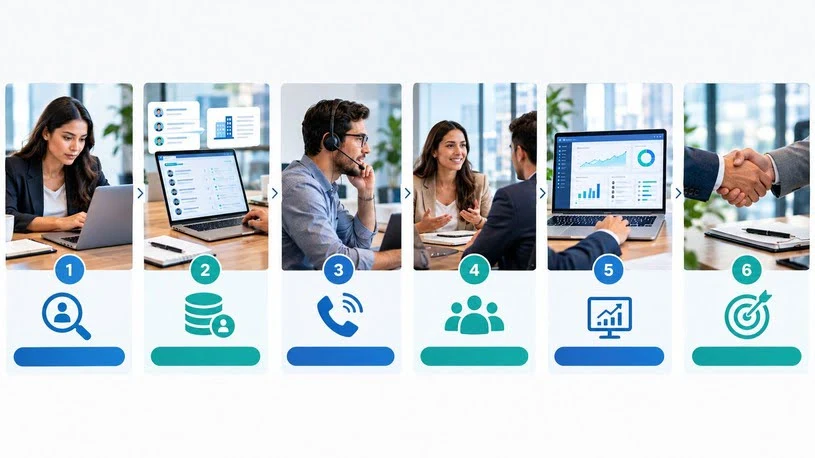
1. Define the Ideal Customer Profile (ICP)
Start by defining the characteristics of companies that are most relevant to your offering.
Typical ICP criteria include:
- Industry
- Company size
- Revenue range
- Geographic market
- Business model
- Existing technology
- Department structure
- Typical business problems
- Use cases your product and service solves
An ICP should be specific enough to eliminate obviously poor-fit accounts. It should not simply describe every company that could theoretically purchase your product.
2. Build a Target Account List
Once the ICP is defined, build a list of companies that match it.
Sources can include:
- Sales intelligence databases
- CRM records
- Industry directories
- Company websites
- Professional networks
- Events and conference lists
- Technology databases
- Existing customer lookalikes
- Account-intent platforms
The objective is to create an account list that can be researched and prioritized rather than an enormous database of unqualified contacts.
3. Identify the Right Contacts
Finding a company is only part of B2B prospecting.
You also need to determine who participates in the purchasing decision.
Depending on the product and organization, relevant stakeholders may include:
- Economic buyer
- Department leader
- End user
- Technical evaluator
- Procurement
- Finance
- Security and legal
- Internal champion
- Executive sponsor
B2B buying committees can contain stakeholders from multiple departments, meaning relying on one contact can leave important decision-makers outside the sales conversation. LinkedIn’s current guidance specifically recommends researching and mapping the broader buying committee rather than treating an enterprise purchase as a single-contact decision.
4. Verify Contact and Company Data
Before outreach, verify the information you intend to use.
At minimum, check:
- Current company
- Current job title
- Business email
- Relevant location and territory
- Company information
- Whether the person is still associated with the account
Data verification is especially important when information comes from databases because job changes, company changes, duplicates, and outdated records can reduce the quality of a prospecting list.
The goal is not merely to find contact data. It is to determine whether the data is current enough to support a legitimate outreach attempt.
5. Research the Prospect and Account
Research should provide context for the conversation rather than become an excuse to spend excessive time on every account.
Useful information includes:
- Firmographics
- Technology stack
- Recent company developments
- Leadership changes
- Hiring activity
- Expansion
- New products
- Funding or acquisition activity
- Existing relationship with your company
- Relevant business problems
- Public signals of changing priorities
HubSpot’s prospect-research guidance emphasizes understanding both the company and the individual before outreach while also keeping research efficient. HubSpot Blog
The exact amount of research should depend on deal value, account importance, available data, and the outreach channel.
6. Prioritize Accounts by Fit and Signals
Not every ICP-fit account should receive the same level of attention.
A practical prioritization model considers both fit and current signals.
For example:
High-priority account
- Strong ICP fit
- Relevant decision-maker identified
- Clear business problem
- Recent trigger and buying signal
- Valid contact information
Medium-priority account
- Good ICP fit
- Relevant stakeholders identified
- Limited evidence of immediate need
Low-priority account
- Weak ICP fit
- Limited stakeholder information
- No meaningful buying and business signal
Buying signals can include business events, research behavior, website activity, technology changes, hiring, acquisitions, and other observable indicators. Intent-data providers describe these signals as clues about whether an account may be researching a relevant solution and moving through a buying process. 6sense
An important distinction is that a signal is not proof that an account will buy. It is information that can help determine where sales attention may be more relevant.
7. Choose the Right Prospecting Channel
B2B prospecting is not synonymous with cold email.
Depending on the account and buyer, channels can include:
- Cold calling
- LinkedIn and other professional networks
- Referrals
- Events
- Partner introductions
- Community engagement
- Account-based outreach
The appropriate channel depends on factors such as buyer preferences, industry, account size, relationship strength, available information, and the nature of the offer.
For complex B2B sales, combining channels can also help sellers reach multiple stakeholders instead of relying on a single communication path.
8. Make the First Contact Relevant
The first message should connect the prospect’s situation with a plausible business reason for the conversation.
Useful personalization can come from:
- A recent company development
- A relevant business problem
- A technology change
- A new role and leadership change
- An industry-specific issue
- A known use case
The goal is not to insert the prospect’s first name into a generic template.
The goal is to show why this account was selected and why the conversation may be relevant now.
9. Use a Prospecting Sequence, Not a Single Attempt
A prospecting process should account for the fact that an unanswered first message does not necessarily mean that the account has no interest.
A sales sequence can coordinate multiple appropriate touches across available channels.
For example:
- Initial email and call
- Follow-up with additional context
- Professional-network touch
- Another relevant follow-up
- Final attempt and future re-engagement
The exact number and timing of touches should depend on the sales cycle, audience, channel, and company policy.
The important principle is to avoid confusing one unanswered message with a definitive buying decision.
10. Qualify the Response
Once a prospect engages, prospecting transitions toward qualification.
Qualification can examine:
- Company fit
- Business need
- Problem severity
- Buying authority
- Timing
- Implementation requirements
- Budget and commercial feasibility where relevant
- Other stakeholders involved
HubSpot’s current qualification guidance distinguishes organization-level, opportunity-level, and stakeholder-level qualification, which is useful for understanding why qualification goes beyond simply asking whether someone is interested. HubSpot Blog
11. Track the Process in a CRM
A scalable prospecting operation needs a reliable record of activity.
Track information such as:
- Target account
- Contact
- Role
- ICP status
- Data-verification status
- Buying signals
- Outreach attempts
- Responses
- Meetings
- Qualification status
- Next action
- Disposition
CRM and sales-workspace systems can connect contacts, tasks, deals, and reporting to the broader sales process. HubSpot Academy
How to Build a B2B Prospecting List
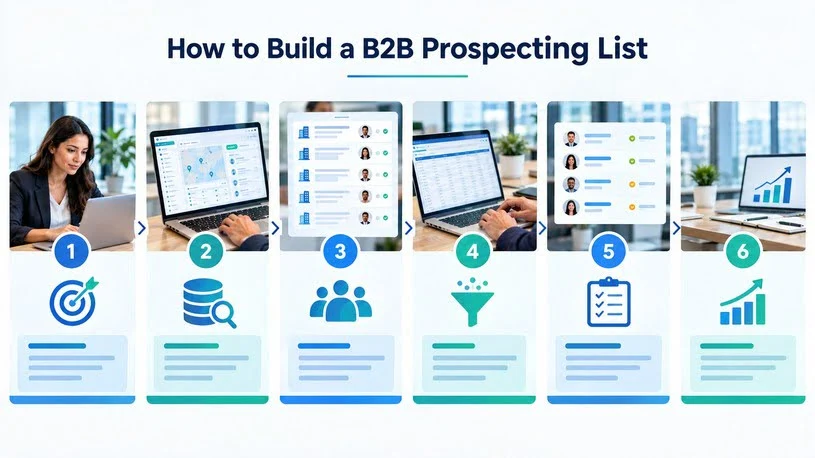
A useful prospecting list should contain more than names and email addresses.
At the account level, consider recording:
| Field | Purpose |
| Company | Identifies the target account |
| Industry | Measures ICP fit |
| Company size | Helps segment accounts |
| Revenue range | Supports account qualification |
| Location | Determines territory and market |
| Technology | Identifies compatibility and replacement opportunities |
| Business signal | Provides a reason to prioritize |
| Existing relationship | Identifies warm paths |
At the contact level, consider:
| Field | Purpose |
| Name | Identifies the person |
| Job title | Indicates likely responsibility |
| Department | Connects the person to the buying process |
| Supports outreach | |
| Professional profile | Provides additional context |
| Decision role | Helps map the buying committee |
| Verification status | Reduces outdated-data risk |
The exact fields should reflect your sales process rather than becoming a checklist for its own sake.
How to Find B2B Decision-Makers
Start with the problem your product solves and identify which department normally owns that problem.
For example:
- Revenue problems may involve sales leadership.
- Security problems may involve security and IT.
- Finance workflows may involve finance leadership.
- HR technology may involve HR and people operations.
Then identify the stakeholders who influence the purchase.
Do not assume the most senior executive is always the correct first contact. In complex B2B purchases, different people can own the business problem, evaluate the technology, use the product, approve the budget, or manage procurement. (LinkedIn Business Solutions)
What Are B2B Buying Signals?
Buying signals are observable indicators that can help sales teams determine whether an account deserves attention.
Examples include:
- Relevant keyword research
- Website activity
- Product and competitor research
- Demo requests
- Content engagement
- New technology adoption
- Company expansion
- New leadership
- Acquisitions
- Funding
- Hiring associated with a relevant function
Intent data platforms commonly aggregate signals such as research behavior, website activity, technology changes, and other account-level activities. 6sense
However, signals should be interpreted in context.
A single website visit does not establish purchase intent. Multiple relevant signals combined with strong ICP fit provide more useful context.
AI Tools for B2B Prospecting
AI and sales-intelligence tools can support different stages of the prospecting process.
| Category | Primary job | Examples |
| Contact & account data | Find companies and contacts | Apollo, ZoomInfo, Cognism, Lusha |
| Intent & signal detection | Identify relevant account activity | 6sense, Dealfront |
| Data verification | Validate and clean contact records | Clearout, Skrapp |
| CRM & sales workflow | Organize contacts, tasks and opportunities | HubSpot, Salesforce |
| AI assistance | Research, summarize, personalize and automate parts of workflows | Depends on platform |
The important question is not simply “Which B2B prospecting tool is best?”
Instead ask:
Which part of my prospecting process is currently inefficient?
If the problem is finding contacts, contact-data software may be relevant.
If the problem is prioritization, intent and account-signal capabilities may matter more.
If the problem is inaccurate records, data verification is the immediate requirement.
If the problem is managing follow-ups, CRM and sales-engagement functionality may be more important.
What Should You Look for in a B2B Prospecting Tool?
Before choosing a tool, evaluate:
- Contact-data coverage
- Data freshness
- Verification capabilities
- Account and firmographic data
- Intent signals
- Search filters
- CRM integrations
- Workflow automation
- AI capabilities
- Geographic coverage
- Compliance controls
- Export and credit limitations
- Pricing model
The best fit depends on your workflow, target market, required data, prospecting volume, and existing technology stack.
Common B2B Prospecting Mistakes
Skipping ICP definition
A large database does not compensate for unclear targeting.
Treating volume as the strategy
Sending more outreach cannot automatically fix poor account selection.
Failing to verify data
Outdated emails and job information reduce list quality and can waste sales activity.
Single-threading important accounts
Relying on one person can leave other stakeholders outside the conversation, particularly in complex B2B purchases. LinkedIn Business Solutions
Ignoring buying signals
An account that fits your ICP but has no relevant current signal may deserve a different priority from an account showing multiple indicators of active research.
Over-researching every prospect
Research should create useful context, not consume unlimited time. HubSpot specifically recommends keeping prospect research efficient rather than spending excessive time on every potential buyer. HubSpot Blog
Using the same message for every account
Personalization is most useful when it reflects a genuine account-specific reason for contacting someone.
B2B Prospecting Metrics to Track
A prospecting program should measure both activity and outcomes.
Useful metrics include:
- Accounts researched
- Contacts identified
- Verified contacts
- Outreach attempts
- Connection rate
- Response rate
- Positive response rate
- Meetings booked
- Meeting-to-qualified-opportunity rate
- Pipeline generated
- Conversion by channel
Activity metrics tell you what the team is doing.
Outcome metrics tell you whether those activities are producing useful sales opportunities.
A high number of emails and calls does not necessarily indicate a healthy prospecting process if those activities produce few qualified conversations.
B2B Prospecting vs. Qualification
Prospecting and qualification should work together but answer different questions.
Prospecting asks:
Who should we contact?
Qualification asks:
Is this a real sales opportunity worth pursuing?
Prospecting can identify a company and stakeholder that appear to fit the ICP. Qualification then investigates whether there is a meaningful problem, appropriate authority, timing, and commercial path.
Keeping these concepts separate makes the sales process easier to measure and manage.
B2B Prospecting Checklist
Before contacting an account, confirm:
- The company matches the ICP
- The relevant business problem is plausible
- The correct department has been identified
- Relevant stakeholders have been mapped
- Contact information has been verified
- A useful account signal has been identified when available
- The chosen outreach channel makes sense
- The first message has a genuine reason for contact
- Follow-up activity is recorded
- Responses are routed into the qualification process
- Prospecting outcomes are measured
Frequently Asked Questions
What’s the difference between B2B prospecting and lead generation?
Lead generation generally focuses on attracting and capturing potential interest, while B2B prospecting proactively identifies target accounts and contacts and initiates sales conversations.
What’s the difference between a lead and a prospect?
A lead is generally an individual and account that has entered the sales and marketing process. A prospect is a potential buyer being evaluated for fit and potential sales relevance. Organizations may define these terms differently.
How do you create a B2B prospecting list?
Define the ICP, identify matching accounts, find relevant stakeholders, collect company and contact information, verify the data, and prioritize accounts using fit and relevant business signals.
How do you find B2B decision-makers?
Identify the department responsible for the problem your solution addresses, then map the people who influence, evaluate, use, approve, and purchase the solution.
What data should be verified before B2B outreach?
At minimum, verify the person’s current company, job title, business email, and other information required by your sales process.
What are B2B buying signals?
Buying signals are observable indicators that may suggest an account is researching a solution and experiencing a relevant business change. Examples include research activity, website engagement, technology changes, expansion, hiring, acquisitions, and other business events. 6sense
Is cold calling the same as B2B prospecting?
No. Cold calling is one prospecting channel. B2B prospecting is the broader process of identifying, researching, prioritizing, and contacting potential buyers.
Do I need a paid B2B prospecting tool?
Not necessarily. Small lists can be researched manually. As prospecting volume increases, sales intelligence, verification, CRM, and workflow tools can reduce manual work. The appropriate tool depends on the size and complexity of the sales process.
Can AI automate B2B prospecting?
AI can assist with tasks such as research, data analysis, prioritization, personalization, summarization, and workflow automation. It does not eliminate the need to define the ICP, validate information, interpret business context, and decide whether outreach is appropriate.
How many contacts should you target at one B2B account?
There is no universal number. The appropriate number depends on deal complexity and the organization’s buying process. For larger and more complex purchases, mapping multiple relevant stakeholders can reduce dependence on a single contact.

James Anderson is a sales professional focused on helping businesses improve their sales process and achieve better results. He is experienced in using sales tool to manage leads track customer interactions identify opportunities and support business growth. William values clear communication strong customer relationships and efficient sales strategies.